
Criminal Court Cases in Franklin County
Franklin County Circuit Court hears felony trials and other criminal matters within a Tennessee court of record. General Sessions Court handles preliminary steps in felony cases, warrants, and misdemeanors within its authority. Juvenile Court is also housed at the same site, but delinquency files are generally restricted. The Tennessee courthouse directory identifies the Franklin County Judicial Center at 440 George Fraley Parkway in Winchester as the shared court location.
Municipal dockets remain separate. Winchester City Traffic Court, Decherd Municipal Court, and Estill Springs Municipal Court keep city or traffic matters within their authority. A city citation may never become a Circuit Court case. If a charge is bound over, indicted, or otherwise enters the county criminal courts, the Franklin County Circuit Court Clerk becomes the place to trace the filed case. That division matters because asking the wrong clerk can produce a truthful no-result for a case held elsewhere.
The 12th Judicial District Public Defender's Franklin court page names the local courts and judges. Its view of the Judicial Center helps a reader place each court before requesting a record.
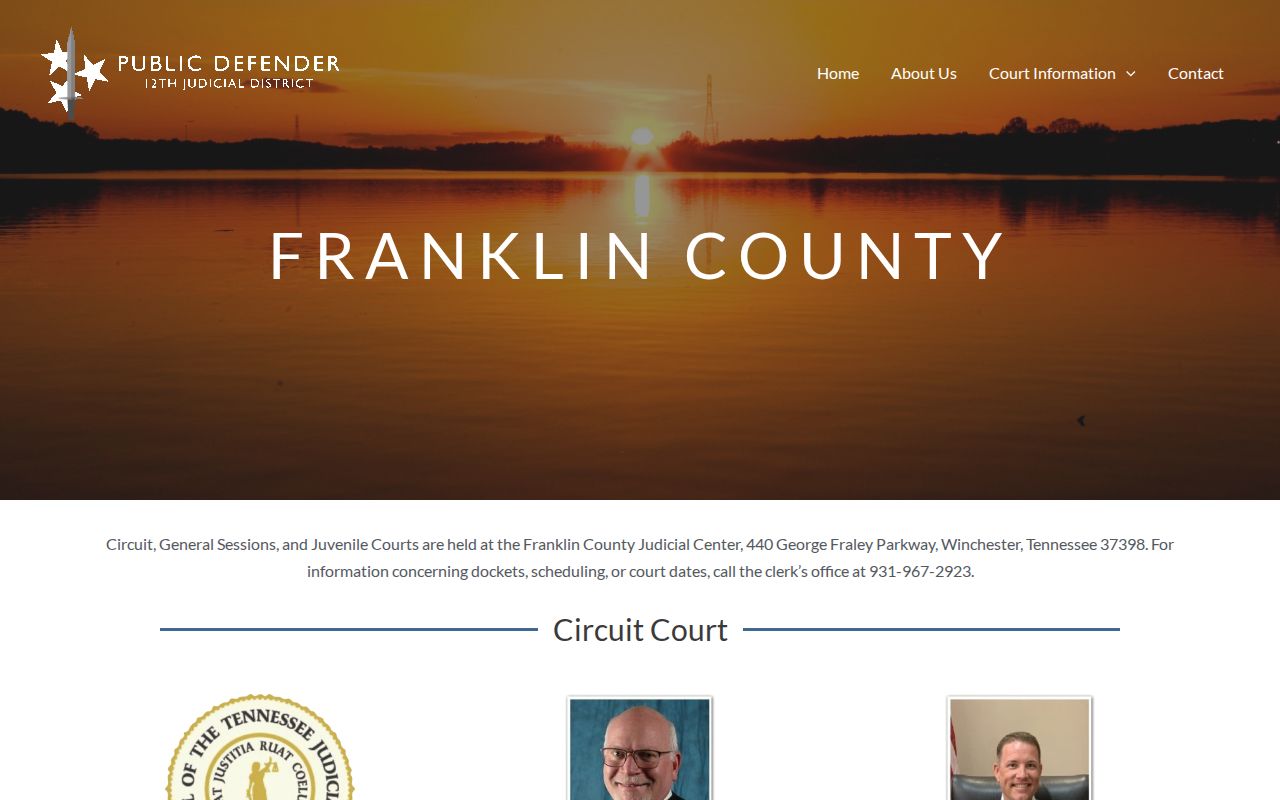
The court listing confirms that the clerk, not the sheriff or public defender, is the custodian for criminal dockets, judgments, and filed court papers.
Franklin County Case Files in Room 157
Circuit Court Clerk Robert Baggett's office is in Room 157 at the Franklin County Judicial Center, 440 George Fraley Parkway, Winchester, TN 37398. The published number is 931-967-2923, and the official clerk listing gives robert.baggett@tncourts.gov. This counter is the direct route for Circuit and General Sessions docket numbers, hearing dates, charging papers, judgments, dispositions, and copy questions. The clerk's indexed official material does not publish a local fee schedule or a guaranteed search turnaround.
Call before sending a broad request. Give the full name, an approximate filing or arrest date, and the case number when known. Ask whether the matter is in Circuit Court or General Sessions Court. A focused request for the register or docket, charging instrument, disposition, and judgment is easier to identify than a request for every paper tied to a name. Older material may require staff help because Franklin County has no verified public trial-court name portal.
Franklin County Circuit Court Clerk
440 George Fraley Parkway, Room 157
Winchester, TN 37398
931-967-2923
Counter hours are not published; call first.
Franklin County Case Record Searches
There is no single public Tennessee trial-court system that provides a complete Franklin County criminal case search. The reliable local route is the clerk by phone, counter, or mail. Tennessee Appellate Courts Public Case History applies only after a matter reaches an appellate court. Use this sequence to avoid confusing an appellate docket, a jail entry, and a county trial file.
- Decide whether the record is a city matter, a General Sessions proceeding, or a Circuit Court case. Start with the court shown on the citation, bond paper, or hearing notice.
- Call the Franklin County Circuit Court Clerk at 931-967-2923 for Circuit or General Sessions records. Give a full legal name and an approximate date.
- Supply the docket number, court part, or originating agency when available. These details help separate similar names and linked cases.
- Ask staff to identify the docket, charging paper, disposition for each count, judgment, and any public copy or certification options.
- If an appeal was filed, use Tennessee Public Case History, then request the underlying trial record from the Franklin clerk.
Because the local search is staff-assisted rather than a public web form, the following details function as request fields. The clerk may ask for more information based on the file.
| Request Detail | Format | Status | Why It Helps |
|---|---|---|---|
| Full name | Text | Needed for a useful search | Identifies the party shown on the docket |
| Docket or case number | Text | If known | Points to one court file |
| Approximate filing or arrest date | Date range | If known | Narrows older and same-name results |
| Court or part | Circuit or General Sessions | If known | Routes the inquiry to the right docket |
| Record requested | Docket, disposition, judgment, or copy | State precisely | Lets staff locate the needed public item |
Franklin County Criminal Cases Across Parts
Franklin County Circuit Court has Parts I, II, and III. The official public defender page lists Bradley Sherman for Part I, John Cameron for Part II, and Justin Angel for Part III. David Stewart is listed for General Sessions and Juvenile Court. A part designation is more than a label. It helps the clerk identify the judge, docket, hearing track, and orders tied to a Franklin County criminal case.
General Sessions often supplies the first court trail for an arrest, complaint, bond decision, or preliminary hearing. A felony may then move through grand-jury action to Circuit Court. Misdemeanors may stay in General Sessions when that court has jurisdiction. The District Attorney General for the 12th Judicial District decides which charges to pursue, while the clerk records the filings and results. The public defender is counsel for eligible defendants, not a records office.
Note: A General Sessions docket and a later Circuit indictment may relate to one event but carry different identifiers and charge descriptions.
What a Criminal Case File Contains
A Franklin County case file organizes events by docket number rather than booking number. Request the disposition for each count, not just the case status. One count may be dismissed while another ends in a plea or trial judgment. The charging language can also change between the initial complaint and an indictment. Reading the whole docket prevents an early accusation from being mistaken for the final outcome.
| Case Number and Court | Identifies the docket, Circuit or General Sessions court, and assigned part where shown. |
|---|---|
| Charging Document | May be an affidavit of complaint, information, or grand-jury indictment with counts and code references. |
| Docket Entries | Chronological filings, motions, orders, appearances, and other public case events. |
| Hearing Dates | Scheduled or completed appearances, subject to later changes recorded by the clerk. |
| Disposition and Judgment | The result for each count, such as dismissal, nolle prosequi, acquittal, plea, or conviction. |
| Sentence and Conditions | Confinement, probation, fines, costs, restitution, and other terms stated in the judgment. |
Bond, counsel, fines, costs, restitution, appeal notices, linked cases, and available public document images may also appear. Ask which fields the clerk can verify in the actual Franklin County file.
Reading Franklin County Case Outcomes
Several docket terms describe outcomes that are not convictions. A no-bill means the grand jury declined to indict that charge. Nolle prosequi means the prosecutor formally chose not to proceed at that time. A dismissal means the court ended the charge without a conviction on it. An acquittal is a not-guilty result after the case was decided by the factfinder. These outcomes are not interchangeable, so use the exact wording in the clerk's disposition.
- Disposition
- The recorded outcome of a charge or case.
- Nolle prosequi
- A formal decision by the prosecutor not to continue that charge at that time.
- No-bill
- A grand jury decision not to return an indictment on the submitted charge.
- Capias
- Court process directing an arrest, often tied to failure to appear or later enforcement.
- Judgment
- The court's formal decision, including guilt and sentence when applicable.
A booking record may still show the first charge after a case ends differently. Compare the arrest trail with the Franklin County arrest search, but rely on the clerk's certified disposition for the court outcome.
Criminal Case Stages in Franklin County
A Franklin County felony often begins with an arrest or citation, an affidavit, and an initial appearance in General Sessions Court. Bond and a preliminary hearing may follow. Grand-jury action can lead to an indictment in Circuit Court, where arraignment, motions, a plea or trial, judgment, and sentence appear on the docket. Charges may be amended or dismissed at several points, which is why the earliest entry should never stand in for the last one.
Case flow: Charges Filed → Arraignment → Pretrial → Plea or Trial → Disposition → Sentencing
The flow is a record map, not a promised timetable. The research sources do not publish standard Franklin County completion times. Hearing dates can change, and one case may stop before later stages. Confirm the current setting with the clerk instead of estimating from a prior docket entry.
Franklin County Criminal Case Appeals
The Tennessee Appellate Courts Public Case History offers a public search for appellate matters. It does not replace the Franklin County trial file. A criminal appeal can reach the Tennessee Court of Criminal Appeals after a final trial-court action, and the appellate docket then tracks briefs, orders, argument, and the appellate result.
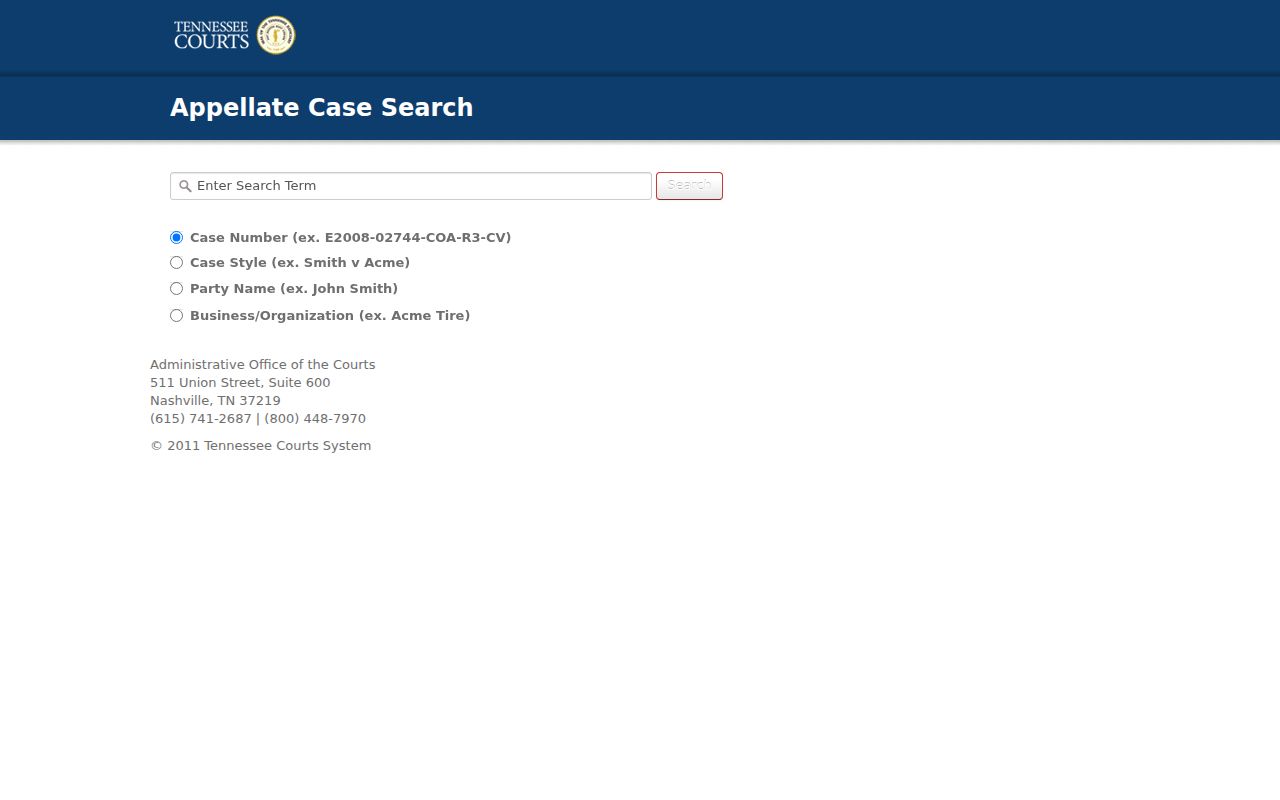
The search image shows the statewide appellate layer. Use the appellate case number or party details there, then return to Room 157 for the complaint, indictment, trial motions, exhibits available to the public, and original judgment.
Searching only PCH can produce a false impression that no Franklin County case exists. Most county criminal matters never become appellate cases. Conversely, an appellate entry may mention only the issues under review, not every fact or document from the lower court.
Missing Franklin County Case Results
A Tennessee Bureau of Investigation history can show an arrest cycle without a later outcome when disposition reporting is delayed or incomplete. First obtain the clerk's docket and certified disposition. Check that the name, arrest date, charge, and case number tie the records together. Then follow TBI Criminal Justice Information Services review or challenge instructions if the state history remains wrong. Changing one web display does not automatically repair every agency record.
For a qualifying dismissal or other eligible outcome, Tennessee uses expungement or statutory expunction under T.C.A. §40-32-101. The request begins in the court that handled the case. TBI cannot erase the Franklin court file without the proper order and reporting chain.
Access Rules for Case Records
Public access does not make every line of a Franklin County criminal case file open. Juvenile matters are generally confidential. Sealed or expunged cases leave ordinary public access. Victim information, protected addresses, Social Security numbers, financial identifiers, medical details, and information covered by a specific law may be removed from a public copy. Active investigative material may also be restricted when held by law enforcement.
Ask the clerk whether a missing record is in another court, offline, sealed, or identified under a different docket. The office may provide inspection or copies under applicable rules, but the indexed sources do not state Franklin County copy fees or a fixed response time. Request an estimate before a large order and say whether certification is needed. A certified judgment carries a different purpose than a screenshot of a docket.
The state courthouse directory is a useful orientation source for Franklin County court case lookup access.
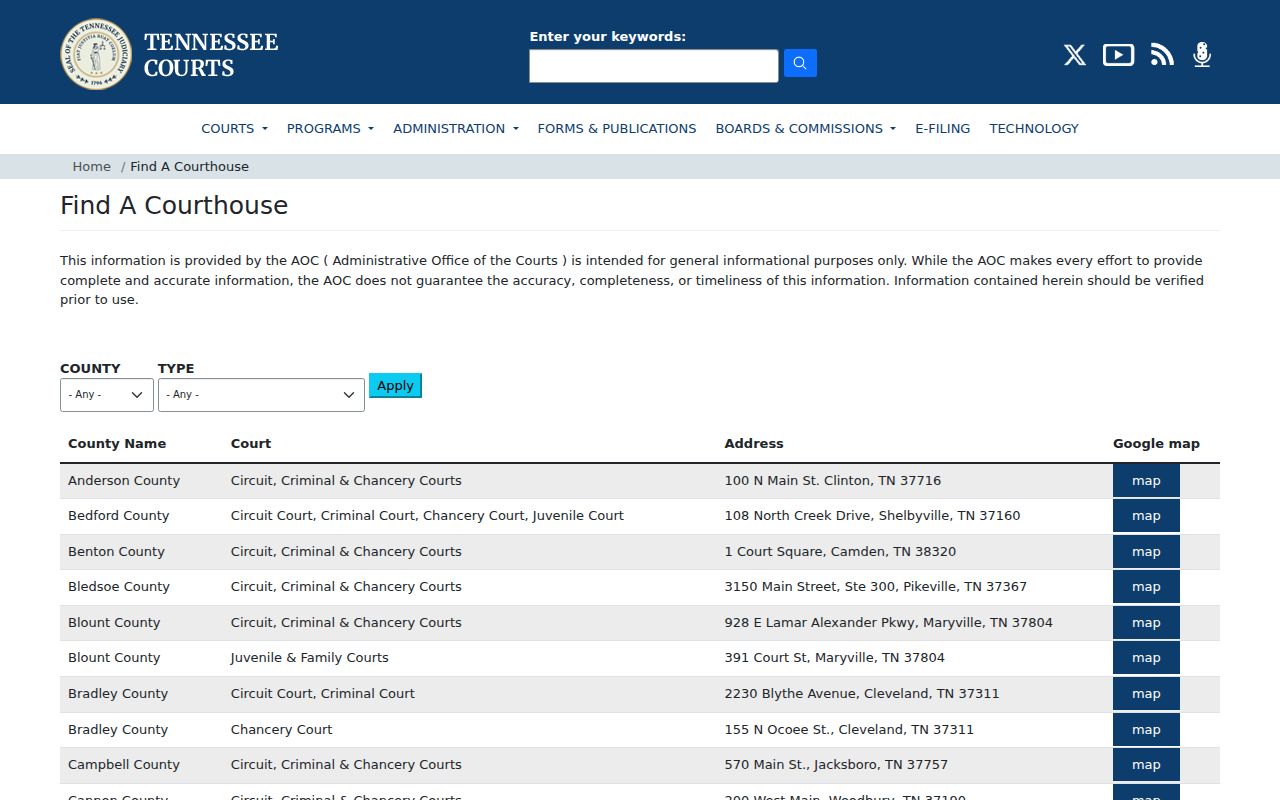
That directory confirms the official location, while the clerk remains the source for current public-file availability, redactions, copy terms, and certified documents.